Translation Centres and Test Beds: The Connective Infrastructure of Innovation Ecosystems

John H. Howard, 11 August 2026
This working paper is one of a series prepared by the Acton Institute for Policy Research and Innovation to inform the UTS research project Turning AI into Productivity: The Role of Innovation Ecosystems, supported by the Google Foundation. The project's final report will be launched by the Minister for Industry and Innovation on 22 September**.

Every strong innovation ecosystem visited during the field program of the UTS research project, Turning AI into Productivity, runs dedicated translation centres. Their job is to move knowledge between research and working firms. When practitioners were asked how AI actually reaches ordinary companies, they pointed to these centres, rather than to universities or government programs.
This paper draws on that field evidence, gathered across fourteen ecosystems in six European and Nordic countries between May and June 2026. It asks three questions. What do translation centres do? Why do the strongest look alike? And what does their absence cost? Fraunhofer, DFKI, the Brainport Industries Campus, VTT, and the Cambridge Institute for Manufacturing anchor the answers, with Australian facilities considered against them.
The Translation Function
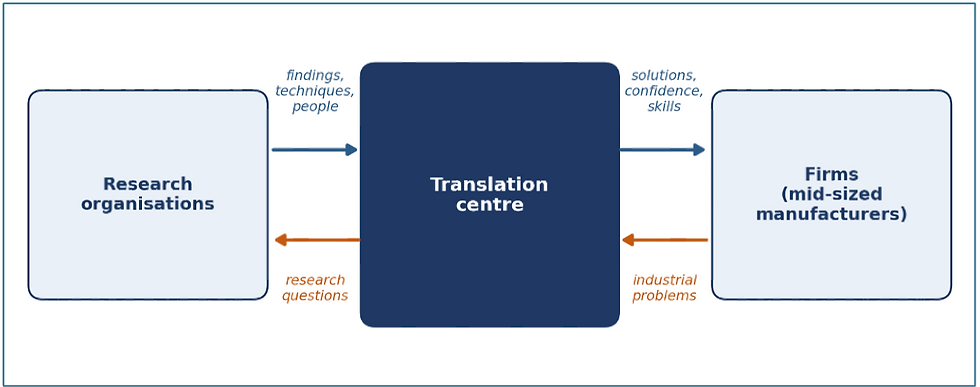
Translation centres carry knowledge between research organisations and users in industrial applications. And it can travel in both directions, as illustrated in Figure 1. It can take research findings to firms in a form they can use, and they bring industrial problems and opportunities back to researchers in a form researchers can work on. The traffic in problems may be worth as much as the traffic in solutions, because it keeps the research agenda alive.
They also take some of the risk out of adoption and application. For a firm without a research department, the gap between an AI pilot and a production deployment is where most efforts stall. Translation centres shrink that gap through shared facilities, staged projects, and hard-won knowledge of what has failed elsewhere. The firm buys confidence as much as technology.
Figure 1: The translation function. Knowledge moves in both directions, and the traffic in industrial problems may be worth as much as the traffic in solutions.
Exemplars from the Field
Fraunhofer: applied research at national scale
The Fraunhofer-Gesellschaft is the largest applied research organisation in Europe, with more than 70 institutes and around 30,000 staff. Each institute specialises by technology and by industry, from production engineering in Stuttgart to software engineering (Fraunhofer IESE) and industrial mathematics (Fraunhofer ITWM) in Kaiserslautern.
The funding model explains much of its behaviour. Roughly one third of income comes as base funding from federal and state governments. The rest must be earned through contract research for industry and competitive public projects. An institute that loses relevance to firms loses revenue. Market discipline is built in, while base funding keeps capability alive between contracts.
Fraunhofer people show the dual fluency seen across the strongest ecosystems. Institute engineers hold academic standing, often through joint appointments with nearby universities, while spending their careers inside industrial problems. Doctoral candidates move through the institutes into firms and take their relationships with them. The network works as a labour market as much as a research system.
DFKI and Kaiserslautern: translation at city scale
The German Research Center for Artificial Intelligence (DFKI) shows the translation function working at the scale of a single city. Founded in 1988 as a non-profit partnership, with industrial shareholders sitting alongside government, DFKI has grown into one of the largest AI research centres in the world. Its founding site is Kaiserslautern.
Kaiserslautern is particularly significant because it is a small industrial city, closer in scale to an Australian regional centre than to Munich or Stockholm. DFKI, the Fraunhofer institutes IESE and ITWM, and the university work as one connected system.
SmartFactory-KL, founded in 2005, runs a working demonstration factory where firms trial Industrie 4.0 and AI techniques under production-like conditions.
The returns have been national. The Industrie 4.0 agenda, which reshaped German manufacturing policy, grew substantially out of this small city. A community of around 100,000 people, with a durable layer of translation centres, shaped the industrial strategy of Europe's largest economy.
Brainport Industries Campus: translation on the factory floor
The Brainport Industries Campus in Eindhoven takes translation onto the factory floor itself. Presented locally as the factory of the future, the campus brings high-tech suppliers, training providers, and research partners under one roof. Tenants share cleanrooms, logistics, warehousing, and flexible production space rather than each building their own.
What makes the campus particularly interesting is what the tenants share beyond the building. Field labs on site let suppliers, students, and researchers test flexible manufacturing and automation techniques on real production equipment. Vocational and applied-science students train metres from working factories, so the skills pipeline and the production system grow together.
The campus sits inside a wider Eindhoven innovation ecosystem. Brainport Development, the regional body owned jointly by municipalities, employers, and knowledge institutions, keeps firms, governments, and educators working to a shared agenda. Orchestration and translation work together; each would be weaker alone.
The Holst Centre, nearby on the High Tech Campus, adds a second translation layer. Founded in 2005 by the Dutch applied research organisation TNO and Belgium's imec, and named after the first director of Philips Research, it develops wireless sensing and thin-film electronics with more than 45 industrial partners. The partners set shared technology roadmaps and place their own researchers on site, so results move straight into member firms.
IfM Cambridge: translation from inside the university
The Institute for Manufacturing (IfM) at the University of Cambridge shows the translation function operating from inside a university rather than alongside one. Part of the Department of Engineering, the IfM combines research in management, technology, and policy with education and direct application in industry, working from the Alan Reece Building on the West Cambridge site.
The IfM disseminates its research through IfM Engage, a knowledge transfer company owned by the University. Engage employs its own practitioners, who carry IfM tools such as technology roadmapping into firms and governments through consultancy and executive education, and its profits are gifted back to the University to fund further research.
The arrangement addresses the university reward-system problem directly. The outward-facing work has its own staff, its own revenue logic, and its own mandate, so it does not compete with the publication economy for academic attention. The research side keeps its academic standing while the Engage side holds the firm relationships.
Two programs extend the reach. Digital Manufacturing on a Shoestring develops low-cost digital solutions for smaller manufacturers, the firms with the most to gain and the least capacity to engage. Cambridge Industrial Innovation Policy, the IfM's policy research group, publishes the annual UK Innovation Report and carries evidence upward into government as industrial strategy develops.
The IfM translates through tools, people, and advice rather than shared production infrastructure; it is not a testbed in the SmartFactory-KL sense. It shows instead that a university can sustain the translation function when the outward-facing layer is given institutional form of its own, a lesson with direct application to Australian university facilities.
VTT: the small-country model
VTT, the Technical Research Centre of Finland, shows the model working at the scale of a small economy. State-owned, with around 2,000 staff, VTT is Finland's national research and technology organisation. Its work runs from quantum computing to the bioeconomy and industrial AI, and its relationships with Finnish industry, including the research communities around Espoo and Otaniemi, run deep.
Two features stand out: VTT holds firm relationships over decades rather than project cycles, and it runs national infrastructure, such as pilot plants and testbeds, that no single firm could justify alone. For an economy of 5.5 million, less than the population of NSW at 8.6 million, one durable translation centre can achieve what a scatter of short-lived programs cannot.
Design Principles for Effective Translation Centres
The strongest translation centres share a design. They are built to last, funded on horizons of decades rather than grant cycles, which lets them hold relationships with firms across business cycles and generations of technology
They employ people who are fluent in both research and industry. These people are the scarce resource. Buildings and equipment can be bought within a budget cycle. A cadre of engineers who publish credibly and can also read a balance sheet takes a generation to grow.
They also carry a mandate to serve ordinary firms. The largest productivity gains from AI may sit with mid-sized manufacturers rather than frontier technology companies, and the strongest centres are pointed squarely at those firms, through subsidised first projects, staged engagement, and a standing presence in their region.
Within the project's Seven-Indicator Assessment Framework, translational capability emerged from the field as the indicator on which the others depend. Shared compute without translators is idle capacity. Testbeds without translators are demonstration theatre. Skills without translators leak to other regions. The translation layer converts ecosystem assets into adoption, which is why the project describes it as connective infrastructure.
The Australian Position
Australia has capable elements. CSIRO carries genuine translational capability, and a layer of university-linked institutes and cooperative research centres does translation work in particular sectors. Even so, the field comparison suggests the Australian translation layer is thinner, less stable in funding, and less consistently pointed at mid-sized firms than its German or Finnish counterparts.
Facilities that face inward
The Australian National Fabrication Facility (ANFF), built under the National Collaborative Research Infrastructure Strategy (NCRIS), links eight university-based nodes holding more than 500 tools and close to half a billion dollars of equipment. Its cleanrooms and prototyping suites are, on paper, exactly what a translation centre needs.
NCRIS has drawn $5.5 billion in bipartisan funding over two decades. Dr Cathy Foley, who chaired the ANFF Victorian node committee for nearly ten years, recalls its best moments as researchers, start-ups, and industry partners able to “walk through the same door” (Foley, 2026).
In practice, facilities of this kind tend to face inward. Access runs through committees weighing research merit, pricing separates academic and industry users, and the surrounding reward system of publications, promotion, and grant income pulls staff toward academic work. ANFF is formally open to industry, and some nodes engage well, but usage appears to lean toward research users.
The same pattern extends to Microscopy Australia's instrument network, to university cleanrooms and pilot plants funded through equipment grants, and to the characterisation laboratories attached to research institutes. The capability is significant, but what is often missing is the outward-facing layer: engineers whose job is the firm's problem, not the next paper.
Foley's case for the next twenty years of NCRIS asks that success be measured by engagement of start-ups, industry users, and trained technicians, and not by publications alone, and that facilities be funded long enough to retain expert staff and work with industry on realistic timeframes.
Facilities that face outward
Flinders University's Factory of the Future, which includes the Line Zero facility at the Tonsley Innovation District in Adelaide, may be the closest Australian relative of SmartFactory-KL. Working from part of the former Mitsubishi assembly plant, it lets shipbuilding and other manufacturing technologies be trialled under production-like conditions before deployment, and draws supply chain firms into the work.
A proposed $67 million expansion, announced in 2024, would extend collaboration to more than 250 companies and train thousands of workers in robotics, automation, and digital manufacturing. Partnerships with the United Kingdom's Advanced Manufacturing Research Centre and the University of Strathclyde tie the facility into international practice.
The UTS Tech Lab at Botany in Sydney brings large-scale engineering infrastructure together with laboratories in communications, sensing, data analytics, and AI on an 18,000 square metre site. Its partnership model is built for start-ups, mid-sized firms, and multinationals, working through staged projects with academic and technical teams.
Swinburne's Factory of the Future, opened in 2015 as Australia's first dedicated Industry 4.0 facility, gives firms a place to co-create digital manufacturing solutions, backed by the Swinburne-CSIRO National Industry 4.0 Testlab in composite additive manufacturing.
RMIT's Advanced Manufacturing Precinct does comparable work, offering firms a single door into additive and digital manufacturing.
The Advanced Manufacturing Readiness Facility (AMRF) at Bradfield, run by the Bradfield Development Authority, is the newest entrant. Built for applied industrial translation, its Manufacturing Hall gives firms access to industrial-grade equipment and engineers for de-risking and scale-up, with early projects spanning aerospace, defence, energy, and medtech.
The AMRF also poses a sequencing question. It is a translation centre with, as yet, no co-located research organisations to translate from or to; the university and research presence planned for Bradfield is still taking shape. Whether a translation centre can be built ahead of the ecosystem it serves, rather than growing up alongside it as the European exemplars did, is the live test.
Table 1 sets the Australian facilities alongside one another. The pattern is orientation rather than capability: the research infrastructure built for academic users faces inward, while the newer generation of facilities has been designed to face firms from the outset.
Table 1: Australian translation facilities discussed in this paper, by orientation.
Facility | Location | Host | Orientation and focus |
Australian National Fabrication Facility (NCRIS) | Eight university nodes, national | University consortium | Largely inward; formally open to industry, usage leans toward research users |
Microscopy Australia and related networks | National | Universities and research institutes | Inward; outward-facing engineering layer often missing |
Factory of the Future, incl. Line Zero | Tonsley, Adelaide | Flinders University | Outward; production-like trialling, supply chain engagement |
UTS Tech Lab | Botany, Sydney | University of Technology Sydney | Outward; staged projects for start-ups, mid-sized firms, and multinationals |
Factory of the Future | Hawthorn, Melbourne | Swinburne, with CSIRO Testlab | Outward; Industry 4.0 co-creation with firms |
Advanced Manufacturing Precinct | Melbourne | RMIT University | Outward; single door into additive and digital manufacturing |
Advanced Manufacturing Readiness Facility | Bradfield, Western Sydney | Bradfield Development Authority | Outward; de-risking and scale-up; co-located research partners still forming |
Taken together, these facilities show the translation function can be built here. The gap being addressed is often institutional, not technical. The university facilities sit inside single institutions and depend on project and program funding, while the European exemplars stand alone, with base funding and national mandates. Scale, durability, and mandate mark the difference, not capability.
Long-term Investment and Policy Implications
Australian translation efforts are commonly tied to program cycles of three to five years, which is shorter than the time it takes to build the trust the function runs on. A centre that must argue for its life at every funding round will struggle to hold the decade-long firm relationships the European exemplars treat as their core asset.
Foley makes the same point for research infrastructure at large. Nobody asks whether Australia should keep its roads and ports; they are maintained because national productivity depends on them. Translation centres deserve the same standing. They are not programs to be renewed but infrastructure to be maintained.
For Australian policy, the lesson is about architecture, not budgets. The question is less about how much to spend than what kind of institution to build: durable, fluent in both the worlds of basic research and industry, and pointed at the firms with the most to gain. Providing the platforms is one thing; the harder task is to build research partnerships and the people around them, rather than assuming they will appear.
References
Advanced Manufacturing Readiness Facility. (2026). About the AMRF. https://www.amrf.sydney
Australian National Fabrication Facility. (2025). About ANFF. https://www.anff.org.au
Brainport Development. (2026). What is Brainport Eindhoven. https://brainporteindhoven.com
Brainport Industries Campus. (2026). About BIC. https://www.brainportindustriescampus.com
CSIRO. (2025). CSIRO and Swinburne Testlab. https://www.csiro.au/en/work-with-us/services/research-and-development/prototyping/testlab
DFKI. (2025). Company profile. https://www.dfki.de/en/web/about-us/dfki-at-a-glance/company-profile
Etzkowitz, H., & Leydesdorff, L. (2000). The dynamics of innovation: From national systems and “Mode 2” to a triple helix of university-industry-government relations. Research Policy, 29(2), 109-123.
Flinders University. (2026). Flinders Factory of the Future. https://www.flinders.edu.au/factory-of-the-future
Foley, C. (2026, 8 July). The ‘quiet’ infrastructure behind Australia’s next industries. InnovationAus. https://www.innovationaus.com/the-quiet-infrastructure-behind-australias-next-industries/
Fraunhofer-Gesellschaft. (2025). Facts and figures. https://www.fraunhofer.de
Fraunhofer IESE. (2025). About Fraunhofer IESE. https://www.iese.fraunhofer.de
High Value Manufacturing Catapult. (2025). About us. https://hvm.catapult.org.uk
Holst Centre. (2025). About Holst Centre. https://www.holstcentre.com
Howard, J. H. (2025). The handbook of innovation ecosystems: Placemaking, economics, business, and governance. Acton Institute Publishing.
Howard, J. H. (2026). Making sense of AI in 2026: A framework for policy and practice. Acton Institute Publishing.
IfM Engage. (2026). Knowledge transfer. University of Cambridge. https://engage.ifm.eng.cam.ac.uk
Innovation Central Adelaide. (2025). Line Zero Factory of the Future. https://www.icentralau.com.au/adelaide/cases/line-zero-factory-of-the-future
Institute for Manufacturing. (2026). About the IfM. University of Cambridge. https://www.ifm.eng.cam.ac.uk
Microscopy Australia. (2025). About us. https://micro.org.au
RMIT University. (2025). Advanced Manufacturing Precinct. https://www.rmit.edu.au/about/our-locations-and-facilities/facilities/research-facilities/advanced-manufacturing-precinct
SmartFactory-KL. (2025). About SmartFactory-KL and Production Level 4. https://smartfactory.de
Swinburne University of Technology. (2025). Factory of the Future. https://www.swinburne.edu.au/research/platforms-initiatives/factory-of-the-future
Tonsley Innovation District. (2025). About Tonsley. https://tonsley.com.au
University of Technology Sydney. (2026). Turning AI into productivity: The role of innovation ecosystems. UTS/Google.org research project.
University of Technology Sydney. (2026). UTS Tech Lab. https://techlab.uts.edu.au
VTT Technical Research Centre of Finland. (2025). About VTT. https://www.vttresearch.com
** Dr John H. Howard is Executive Director of the Acton Institute for Policy Research and Innovation, Sydney, and Research Director of the UTS research project Turning AI into Productivity: The Role of Innovation Ecosystems, supported by the Google Foundation. The project is led by Emeritus Professor Roy Green AM, Special Innovation Adviser at the University of Technology Sydney, who reviewed drafts of this paper and contributed advice on its argument and policy framing.
The paper draws on research undertaken for the project, including visits to 14 innovation ecosystems across eight European countries in May and June 2026. Responsibility for the views expressed, and for any errors or omissions, rests with the author.


Comments